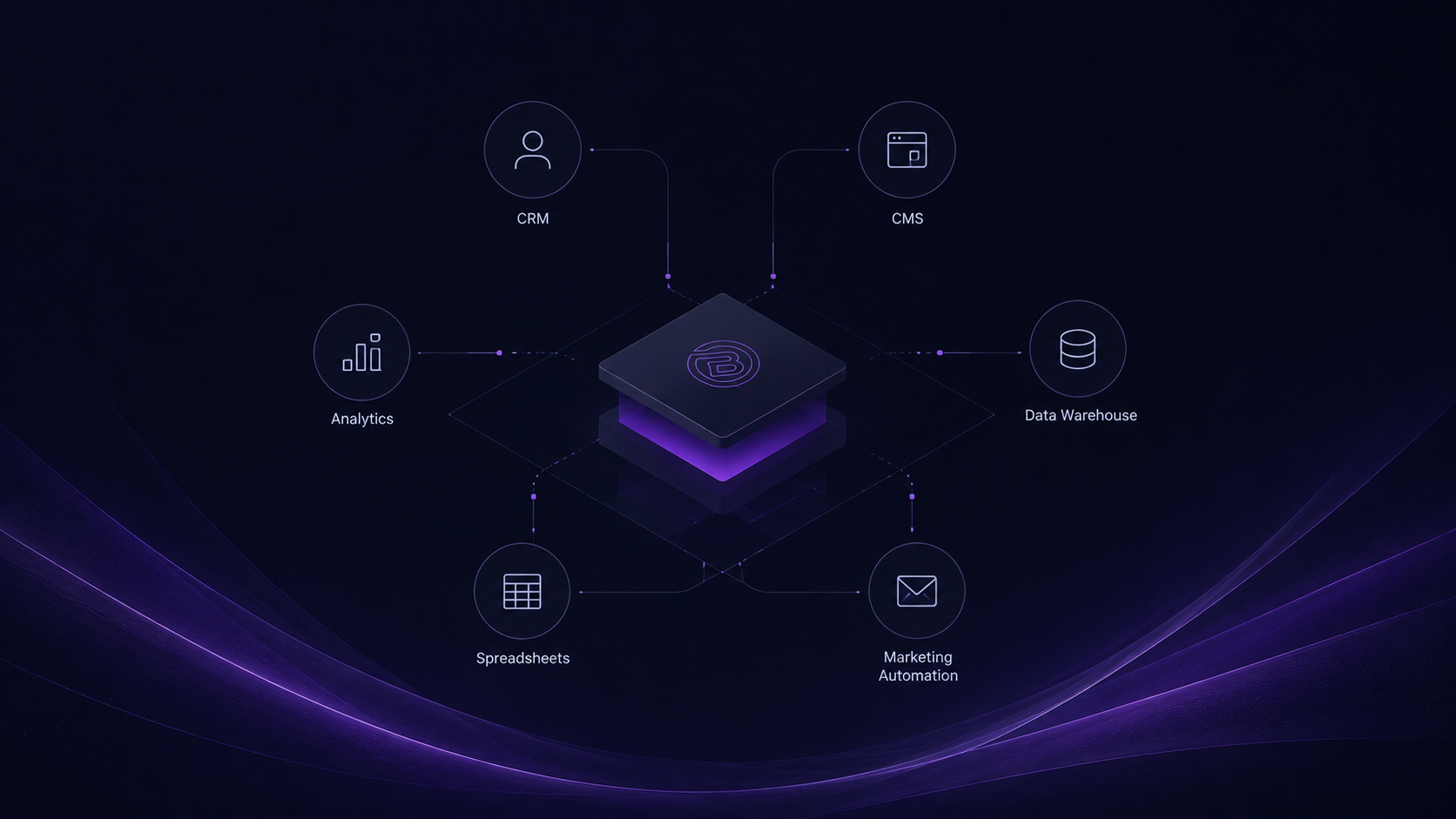
You work for a CPG brand, an agency, perhaps or even a fintech start up. You bought the tools, you hired the right talent.
You have a CRM. A CMS. An analytics platform. Marketing automation. Maybe a data warehouse. Probably a few things running in spreadsheets that were supposed to be temporary three years ago.
And yet, something still doesn't work.
Campaigns go out without the right data behind them. Reporting takes a day to pull together and still doesn't tell you what you actually need to know. Your team is spending time moving information between systems that were supposed to talk to each other.
You're not missing another tool or enterprise offering. You're missing a foundation.
The gap nobody names
Every platform you've ever bought came with a promise. Better visibility. Faster decisions. Less manual work. A single source of truth.
The promise wasn't wrong. The tools can do those things. The problem is that no tool, not even a great one, can deliver on that promise inside a disconnected ecosystem.
When your CRM doesn't talk to your CMS. When your analytics don't reflect what's actually in your database. When your team has to manually reconcile systems that were supposed to sync automatically; the tools aren't failing… The infrastructure between them is.
This is the gap. And it's almost never the thing anyone fixes first.
What usually happens instead
When something isn't working, the instinct is to add. Add a new platform. Add an integration. Add a layer of automation on top of the existing stack.
Sometimes that helps. More often, it makes things harder to untangle later.
We think of it like a chandelier without a house. Expensive, impressive and hanging from crumbling ceilings. You can keep adding fixtures. It doesn't matter if the structure underneath isn't built to hold them.
What "ecosystem" actually means
We use the word ecosystem deliberately, because it's the right word for what most companies are actually missing.
An ecosystem isn't a list of tools. It's the set of relationships between them: how data flows, where it gets stuck, what depends on what, and what breaks when something changes.
A healthy ecosystem means:
- Your systems share the right data at the right time, without manual intervention
- Your team spends time on decisions, not on moving information between platforms
- When you add something new, it connects cleanly; it doesn't require rebuilding what's already there
- You know what you have, what it does, and what it would take to change it
- You can actively measure success of what you're doing and ROI
Most companies have a giant list of software and tools to build this. What they're missing is a clear picture of where the gaps are, what's causing them, and what it would actually take to close them.
When your ecosystem is working, your team spends time making decisions, not moving data between platforms. When you add something new, it connects cleanly instead of requiring a rebuild.
And sometimes, the right call isn't to connect a tool at all, it's to replace it with something you actually own and build proprietary experiences around.
Where to start
Start building ecosystems. Stop buying products.
Brand & Bot builds the connected infrastructure your tools were promised to be and replaces the ones that aren't worth saving. We fix your foundation while we build for you, and we don't leave until your team owns it.
The time to capture the market with the right technology is now. Let's build it right the first time.